
Never Lose WordPress Form Submissions: Retry Queues
Timeouts, quota limits, and brief outages silently eat form submissions. A retry queue with exponential backoff, a delivery log, and a manual retry button makes every submission land eventually.
In This Guide
- Why Is 'It Usually Works' Not Good Enough?
- What Actually Breaks Between WordPress and Your Sheet?
- What Does a Silently Lost Submission Cost?
- What Is a Retry Queue?
- How Does Exponential Backoff Work?
- What Does an Industry-Standard Retry Schedule Look Like?
- Why Do You Need a Delivery Log and a Retry Button?
- Email Alerts vs Fire-and-Forget vs Queued Retries
- How Does SheetLink's Retry Queue Keep Submissions Safe?
- Next Step: Audit How You Fail Today
- Frequently Asked Questions
Why Is 'It Usually Works' Not Good Enough?
You never lose WordPress form submissions once a retry queue sits between your forms and your spreadsheet. You lose them when delivery is fire-and-forget. Webhook infrastructure firm Hookdeck, which has processed well over 100 billion webhooks, treats any delivery success rate below 99% as a problem that warrants investigation (Hookdeck, 2025).
Flip that threshold around and it gets uncomfortable. Even a pipeline operating right at 99% will see roughly one first-attempt failure per hundred submissions. On a site collecting a thousand leads a month, that is about ten deliveries failing on the first try. Whether those ten leads survive depends entirely on what your setup does after a failure.
This post covers why deliveries fail, what the industry-standard retry pattern looks like in practice, and how a queue with exponential backoff, a delivery log, and a manual retry button turns "usually works" into "eventually always lands".
What Actually Breaks Between WordPress and Your Sheet?
Four failure modes cover almost everything: network timeouts, API quota or rate limits, transient outages at the receiving end, and slow responses that exceed your server's patience. None of them mean your setup is broken. They mean the internet between two systems is occasionally unreliable, which has always been true and always will be.
Timeouts are the most common. Your WordPress server sends the submission as a webhook, waits a few seconds for a response, and gives up if none arrives. The receiving side may even have processed the request successfully; the confirmation just came back too late. Quota and rate limits behave differently: the receiver actively refuses the request and keeps refusing until a usage window resets, which can take minutes or a full day.
Transient outages round out the list: a deploy at the wrong moment, a brief Google service hiccup, a DNS blip, a hosting network flap. Each one lasts seconds to minutes. A single delivery attempt during that window fails; the exact same attempt five minutes later succeeds without complaint.
What Does a Silently Lost Submission Cost?
A lost submission is a lost lead, and usually the most expensive kind: someone who already raised their hand and asked to be contacted. Among 602 surveyed CRM users, 37% report losing revenue to poor data quality (Validity, 2025), and a lead that never arrived anywhere is the purest form of bad data there is.
The damage compounds because nobody notices it happening. The visitor believes they contacted you and waits. Your team believes the sheet is complete and works what they can see. There is no error page, no bounce, no alert. The first symptom is a prospect mentioning weeks later that they never heard back, long after the deal went elsewhere.
Silent loss also quietly corrupts your metrics. You cannot track lead response time on a lead that never landed, and response speed matters most for exactly these hand-raisers who expected a reply the same day.
What Is a Retry Queue?
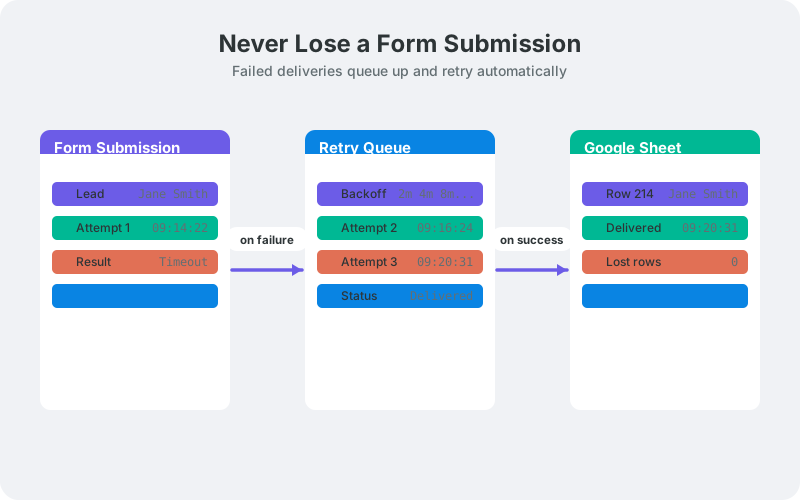
A retry queue is a holding area for failed deliveries. When a send fails, the full payload is stored locally along with its destination, its attempt count, and a next-retry timestamp. A background job then re-sends it on a schedule until it either succeeds or reaches a maximum number of attempts.
The key property is that failure becomes a state instead of an ending. A fire-and-forget send has two outcomes: delivered or gone. A queued send has three: delivered, waiting to retry, or parked for a human after the final attempt. The submission itself is never destroyed by a network problem, because the copy in the queue outlives the failed request.
Queues also decouple your visitor from your infrastructure. The form can confirm instantly because delivery no longer has to succeed inside the page request. Retries happen in the background, invisible to the person who submitted, on whatever schedule gives the destination the best chance of accepting.
How Does Exponential Backoff Work?
Exponential backoff spaces retries at growing intervals: seconds first, then minutes, then hours. The accepted best practice is exponential backoff with jitter, using 6 to 8 attempts spread across 24 to 48 hours (Hookdeck, 2025). Early retries catch momentary blips; late retries outlast real outages and daily quota resets.
The growth pattern is deliberate, not lazy. Retrying every second hammers a service that is already struggling and can stretch a small outage into a longer one. Backing off gives the receiver room to recover. Jitter, a small random offset added to each wait, prevents a thundering herd where hundreds of queued deliveries all wake up and retry at the same instant.
The long tail matters more than it looks. An API quota exhausted at 4 p.m. often resets overnight. A retry schedule that gives up after ten minutes never sees that reset; a schedule that stretches into the next day sails through it and delivers everything that queued up in the meantime.
What Does an Industry-Standard Retry Schedule Look Like?
Svix, a company whose entire product is webhook delivery, defaults to 8 attempts over roughly 28 hours: immediately, then 5 seconds, 5 minutes, 30 minutes, 2 hours, 5 hours, 10 hours, and 10 hours, after which the message is dead-lettered for manual handling (Svix docs).
Read the shape of that schedule, because the shape is the lesson. Three attempts land inside the first few minutes, since most failures are blips that clear almost immediately. The remaining five stretch across more than a day, because failures that survive the first few minutes are usually outages or exhausted quotas, and those need hours to clear, not seconds.
The dead-letter step is the honest part. No schedule can guarantee delivery to a receiver that stays broken forever, so a well-designed system eventually stops retrying and hands the payload to a human with full context, rather than pretending or silently dropping it.
Why Do You Need a Delivery Log and a Retry Button?
A retry queue without visibility is a black box that fails politely. A delivery log shows every attempt for every submission: destination, timestamp, response, and current state. A manual "Retry Now" button closes the loop, letting you re-send a parked payload the moment you have fixed whatever caused the failure.
Logs turn debugging from archaeology into reading. When a client asks where Tuesday's leads went, you open the log, see three deliveries waiting on a quota error from Tuesday afternoon, and answer the question in one minute instead of one afternoon. Our troubleshooting guide walks through the most common log patterns and what each one means.
Manual retry matters most for the dead-lettered tail. Fixed a renamed sheet tab or an expired connection? Press retry and the original payload, byte for byte, goes through. No asking visitors to resubmit, no CSV surgery, no reconstructing a lead from a half-remembered phone call.
Email Alerts vs Fire-and-Forget vs Queued Retries
Email notifications are an alert channel, not storage: they bounce, get spam-filtered, and trap lead data in unstructured inbox threads. Fire-and-forget webhooks deliver clean structured data but destroy it on failure. Queued retries are the only pattern of the three where a failed first attempt still ends, eventually, in a delivered row.
The table below puts the three side by side. The honest summary: email is a decent heartbeat and a terrible database, and fire-and-forget is perfectly fine right up until the afternoon your API quota runs out and a week of Tuesdays goes missing.
Belt-and-suspenders is a reasonable strategy here. Keep the email notification switched on as a heartbeat, deliver the structured data through a queue, and you have two independent paths that fail for different reasons at different times. The odds of both failing on the same submission are small.
How Does SheetLink's Retry Queue Keep Submissions Safe?
SheetLink Forms ships an automatic retry queue with exponential backoff in the free plugin, alongside a per-submission delivery log and a manual Retry Now button. Since version 1.11.1, retries cover both destinations, so failed Google Sheets and failed Excel Online deliveries queue and recover in exactly the same way.
It slots into the standard pipeline without extra configuration: your form plugin fires, the submission goes to your sheet in real time, and anything that fails on the first attempt enters the queue instead of vanishing. The wider pipeline, from choosing a form plugin to structuring the sheet, is covered in our complete WordPress forms to Google Sheets guide.
One tuning tip: filter junk before it ever queues. Retrying spam wastes attempts, pollutes the log, and buries real failures in noise. Pair the queue with spam filtering before the sheet so the retry machinery spends its effort only on submissions that matter.
Next Step: Audit How You Fail Today
Run a simple test this week: temporarily rename your destination sheet tab, submit a test form, then rename the tab back. If that submission is now sitting in a queue with a retry scheduled, you are covered. If it is simply gone, you have just learned exactly what happens to real leads during real hiccups.
Reliability is not about preventing failures; the network guarantees you a steady trickle of them. It is about making failure a recoverable state. A queue with backoff, a log you can actually read, and a retry button you can press covers all of it, and from that point on, "lost submission" stops being a category of problem your business has.
| Email notification only | Fire-and-forget webhook | Queued retries | |
|---|---|---|---|
| Where the data lives | Inbox threads | Sheet, when delivery works | Sheet, plus a stored queue |
| On first failure | Bounces or hits spam | Submission is gone | Automatic retry with backoff |
| Visibility into failures | None | None | Per-submission delivery log |
| Recovery path | Search your inbox | Ask the lead to resubmit | Manual Retry Now |
| Typical attempts | One | One | 6-8 over 24-48 hours |
Frequently Asked Questions
Why do WordPress form submissions fail to reach Google Sheets?
Usually one of four transient causes: network timeouts, API rate or quota limits, brief outages at the receiving end, or slow responses your server gives up on. Most last seconds to minutes, which is why a delayed second attempt so often succeeds where the first failed.
What is a retry queue in WordPress?
It is a stored list of failed deliveries. Each entry keeps the full submission payload, its destination, and a next-attempt time. A background process re-sends entries on a backoff schedule until they succeed or hit the attempt limit, so a failed send is paused rather than lost.
How many retry attempts should a webhook make?
Six to eight attempts over 24 to 48 hours, using exponential backoff with jitter, is the accepted best practice (Hookdeck, 2025). Svix's default is similar: 8 attempts across roughly 28 hours before dead-lettering. Fewer attempts miss quota resets; unbounded retries hammer broken receivers.
Does the retry queue work for Excel Online as well as Google Sheets?
Yes. Since SheetLink Forms 1.11.1, the retry queue, delivery log, and manual Retry Now cover both destinations, so a failed Excel Online delivery queues and recovers exactly like a failed Google Sheets delivery. That matters if you mirror submissions to both spreadsheets at once.
Are email notifications a reliable backup for form submissions?
No. Email is an alert channel, not storage: notifications bounce, land in spam folders, and leave your data unstructured in inbox threads. Keep them on as a heartbeat, but rely on queued delivery to a spreadsheet for the record your team will actually work from.
What happens after the final retry attempt fails?
The delivery is parked in a dead-letter state with its payload intact and the failure visible in the delivery log. Fix the root cause, such as an expired connection or renamed tab, then press Retry Now to re-send the original submission without asking anyone to resubmit.
What webhook delivery success rate should I expect?
Treat anything below 99% as a signal to investigate, the threshold Hookdeck applies after processing well over 100 billion webhooks (Hookdeck, 2025). With a proper retry schedule on top, eventual delivery runs higher still, because transient failures recover on later attempts.
Why not retry a failed delivery immediately and repeatedly?
Because rapid immediate retries hammer a receiver that is already struggling and burn through rate limits even faster. Exponential backoff with jitter spreads attempts out, gives the destination time to recover, and stops hundreds of queued deliveries from all retrying at the same instant.
More Automation guides
Stop Losing Form Submissions to Silent Failures
Automatic retries with backoff, a delivery log, and one-click recovery for Sheets and Excel. No Zapier, no monthly task limits.